Leonardo AI vs Midjourney for Game Assets
Comparing Leonardo AI and Midjourney for game asset creation. Which platform offers better features for game developers?
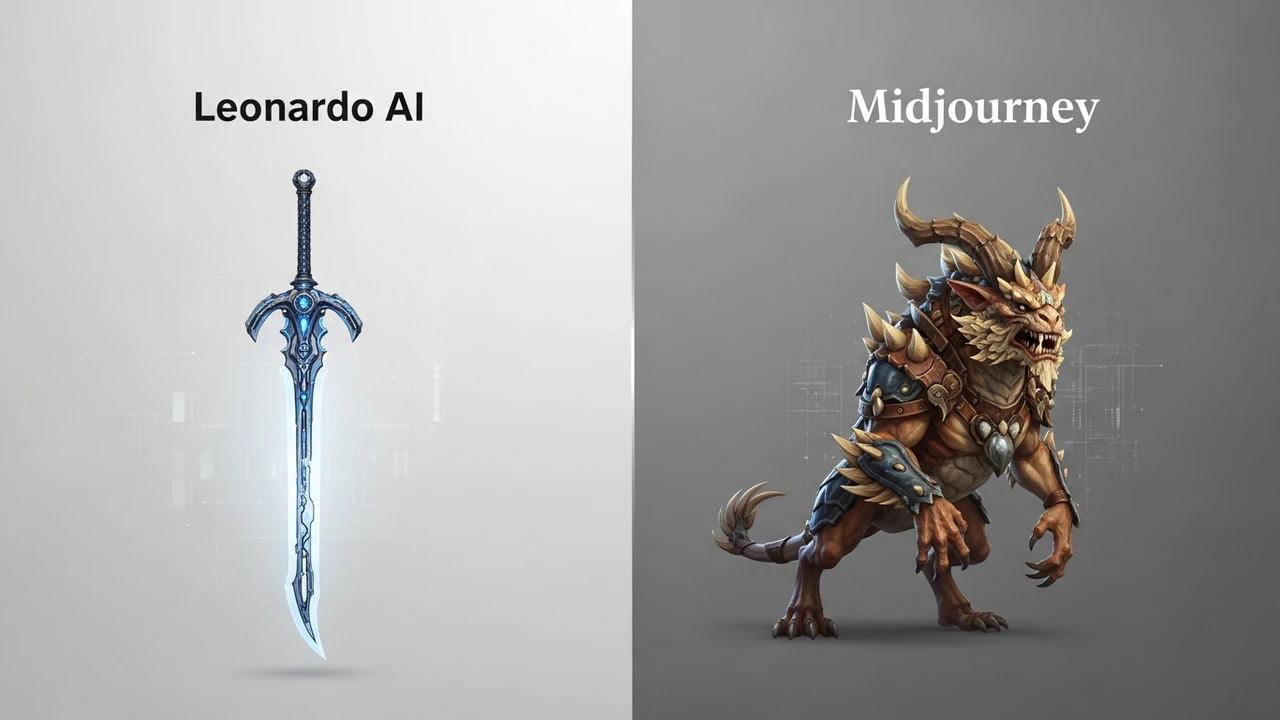
Leonardo AI vs Midjourney for Game Assets
Comparing Leonardo AI and Midjourney for game asset creation. Which platform offers better features for game developers?
Why Game Developers Are Choosing AI for Asset Creation
If you have been hanging around the indie game dev scene lately, you know the struggle. You have a brilliant game mechanic, but your art pipeline is stuck in the mud. Hiring a full-time concept artist is expensive, and doing it yourself takes forever. That is where generative AI comes in. It is not about replacing artists; it is about supercharging your workflow. Today, we are diving deep into the heavyweight battle between Leonardo AI and Midjourney to see which one actually deserves a spot in your production pipeline.
Midjourney The Artistic Powerhouse
Midjourney has become the gold standard for high-fidelity, artistic imagery. When you need a concept art piece that looks like it belongs in a AAA title, Midjourney is usually the first tool you reach for. Its ability to understand complex prompts and deliver stunning lighting, composition, and texture is unmatched. For game developers, this is a godsend for creating mood boards, character concepts, and environment sketches. However, it is not without its quirks. You have to work through Discord, which can feel a bit clunky if you are trying to manage a professional asset library. Plus, the lack of fine-grained control over specific elements can be frustrating when you need a character to hold a specific weapon in a specific pose.
Leonardo AI The Developer Friendly Alternative
Leonardo AI feels like it was built with the game developer in mind. Unlike Midjourney, it has a dedicated web interface that feels like a professional tool. The real kicker here is the control. Leonardo offers features like Canvas Editor, which allows for in-painting and out-painting. This is huge for game assets. Need to extend a background for a parallax effect? Leonardo handles that. Want to keep a character consistent across multiple poses? Leonardo’s training models allow you to upload your own assets to fine-tune the AI, ensuring your hero character looks the same in every single sprite sheet. It is less about 'magic' and more about 'utility'.
Comparing Features for Game Asset Pipelines
When we look at the technical side, the differences become even clearer. Midjourney is a black box. You type a prompt, you get a beautiful image, but you have limited control over the output’s structure. Leonardo AI, on the other hand, gives you access to different models like Stable Diffusion variants, which means you can control the 'seed' and the 'weight' of your prompts much more effectively. If you are building a 2D platformer and need consistent tile sets, Leonardo’s ability to generate seamless textures is a massive time-saver. Midjourney can do textures, but getting them to tile perfectly is often a game of trial and error.
Pricing and Accessibility for Indie Studios
Let’s talk money because that is usually the deciding factor for small teams. Midjourney operates on a subscription model that starts around $10 a month, but to get the 'stealth mode' and commercial rights, you are looking at higher tiers. It is affordable, but you are paying for the brand and the quality. Leonardo AI offers a generous free tier that lets you test the waters without dropping a dime. Their paid plans are also quite competitive, often providing more 'generations' per dollar than Midjourney. For a solo dev or a tiny team, Leonardo’s pricing structure feels a lot more forgiving as you scale up your production.
Practical Use Cases in Game Development
Imagine you are designing a fantasy RPG. You need 50 different icons for inventory items. In Midjourney, you might spend hours rerolling prompts to get a consistent style. In Leonardo AI, you can train a small model on a few sample icons you’ve already created, and then generate the rest in that exact style. This is the difference between a 'cool tool' and a 'production tool'. For environment design, Midjourney is great for the 'big picture' concept, but Leonardo is better for the 'nitty-gritty' asset generation where consistency is king.
Final Thoughts on Choosing Your Tool
At the end of the day, you don't necessarily have to pick just one. Many successful indie devs use Midjourney to brainstorm the initial vision and then switch to Leonardo AI to refine those assets and make them game-ready. If you value artistic flair and raw beauty, Midjourney is your best friend. If you value workflow integration, consistency, and technical control, Leonardo AI is the clear winner. Start by playing with the free tiers of both, see which interface clicks with your brain, and start building that game you have been dreaming about.
:max_bytes(150000):strip_icc()/277019-baked-pork-chops-with-cream-of-mushroom-soup-DDMFS-beauty-4x3-BG-7505-5762b731cf30447d9cbbbbbf387beafa.jpg)